
Mouse Secondary Antibodies


Biotium Epstein-Barr Virus (LMP-1)(CS1-4), CF488A conjugate, 0.1mg/mL
This antibody is a mixture of four different monoclonal antibodies. This antibody is specific to 60 kDa latent membrane protein (LMP-1) encoded by the BNLF1 gene of the EBV. Each clone reacts with different epitopes on the hydrophilic C-terminus of the cytoplasmic domain of LMP-1. This antibody stains strongly with EBV-positive lymphoblastoid cell lines and EBV infected B cell immunoblasts in infectious mononucleosis. EBV, also designated human herpesvirus 4 (HHV-4), is a member of the herpesvirus family and is one of the most common human viruses. EBV infects B cells and, though often asymptomatic, it can cause infectious mononucleosis, a disease characterized by fatigue, fever, sore throat and muscle soreness. Primary antibodies are available purified, or with a selection of fluorescent CF Dyes and other labels. CF Dyes offer exceptional brightness and photostability. Note: Conjugates of blue fluorescent dyes like CF405S and CF405M are not recommended for detecting low

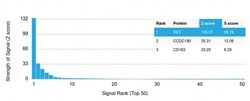
Biotium RET Proto-oncogene(RET/2976), CF740 conjugate, 0.1mg/mL
The Ret proto-oncogene is structurally related to the growing family of tyrosine kinase transmembrane receptors and is involved in GDNF signaling. RET expression is reported in several regions of the central nervous system; in the developing cranial nerve ganglia and a subset of cells within dorsal root ganglia, in motor neurons in the spinal cord and hindbrain, in neuro-retina and the growing tips of the renal collecting ducts in developing kidney. Alterations in RETgene are associated with diseases including papillary thyroid carcinoma, multiple endocrine neoplasia (type 2A and 2B), familial medullary thyroid carcinoma, and a congenital developmental disorder known as Hirschsprung's disease. Primary antibodies are available purified, or with a selection of fluorescent CF Dyes and other labels. CF Dyes offer exceptional brightness and photostability. Note: Conjugates of blue fluorescent dyes like CF405S and CF405M are not recommended for detecting low abundance targets,
Biotium Cdc20(CDC20/1102), CF740 conjugate, 0.1mg/mL
Cyclins, regulatory subunits that associate with kinases, control many of the important steps in cell cycle progression. The Cdc2 protein kinase (p34Cdc2) exhibits protein kinase activity in vitro and exists in a complex with both cyclin B and a protein homologous to p13SUC1. Cdc2 kinase is the active subunit of the M phase promoting factor (MPF) and the M phase-specific Histone H1 kinase. The p34Cdc2/cyclin B complex is required for the G2 to M transition. An additional cell cycle-dependent protein kinase, termed p55cdc, exhibits a high degree of homology with the S. cerevisiae proteins Cdc20 and Cdc4. The p55cdc transcript is readily detectable in a variety of cultured cell lines in growth phase, but disappears when cell growth is chemically arrested.Primary antibodies are available purified, or with a selection of fluorescent CF Dyes and other labels. CF Dyes offer exceptional brightness and photostability. Note: Conjugates of blue fluorescent dyes like CF405S and CF405M a
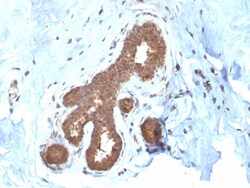
Biotium Glutathione S-Transferase Mu2 (GSTM2)(CPTC-GSTMu2-2), CF740 conjugate, 0.1mg/mL
Recognizes Glutathione S-Transferase of the mu class, which is involved in the detoxification of toxins, drugs, and products of oxidative stress by conjugation with glutathione. Primary antibodies are available purified, or with a selection of fluorescent CF Dyes and other labels. CF Dyes offer exceptional brightness and photostability. Note: Conjugates of blue fluorescent dyes like CF405S and CF405M are not recommended for detecting low abundance targets, because blue dyes have lower fluorescence and can give higher non-specific background than other dye colors.
Biotium Galectin-13 (GAL13) / Placental Protein 13 (PP13) (PP13/1165), 0.2mg/mL
This antibody recognizes a 32 kDa protein, which is identified as homodimer of galectin-13 (also known as PP13). Galectins are a family of soluble beta-galactoside-binding lectins that modulate cell-to-cell adhesion and cell-to-extracellular matrix (ECM) interactions and play a role in tumor progression, pre-mRNA splicing and apoptosis. One such member, galectin-13, is a 139 amino acid protein that contains one galectin domain. Possessing lysophospholipase activity, galectin-13 exists as a disulfide-linked homodimer. Galectin-13 is suggested to have a developmental role in the placenta and may display immunobiological activity in feto-maternal blood-spaces. Screening for galectin-13 in maternal serum during the first trimester of pregnancy may serve as a diagnostic marker to predict preterm pre-eclampsia.Primary antibodies are available purified, or with a selection of fluorescent CF Dyes and other labels. CF Dyes offer exceptional brightness and photostability. Note: Co

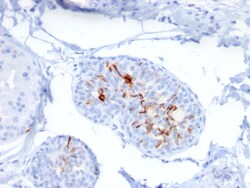
Biotium ZNF690 / ZSCAN29(ZSCAN29/2610), 0.2mg/mL
Zinc finger proteins contain DNA-binding domains and have a wide variety of functions, most of which encompass some form of transcriptional activation or repression. The majority of zinc finger proteins contain a Kruppel-type DNA binding domain and a KRAB domain, which is thought to interact with KAP1, thereby recruiting histone modifying proteins. Zinc finger protein 690 (ZNF690), also known as ZSCAN29, is a 851 amino acid member of the Kruppel C2H2- type zinc finger protein family. Localized to the nucleus, ZNF690 contains six C2H2-type zinc fingers and one KRAB domain through which it is thought to be involved in DNA-binding and transcriptional regulation. Four isoforms of ZNF690 exist as a result of alternative splicing events. Primary antibodies are available purified, or with a selection of fluorescent CF Dyes and other labels. CF Dyes offer exceptional brightness and photostability. Note: Conjugates of blue fluorescent dyes like CF405S and CF405M are not recommend
Biotium PTH / Parathyroid Hormone (N-Terminal)(PTH/1173), Biotin conjugate, 0.1mg/mL
The epitope of this MAb maps in the C-terminus of PTH, a hormone produced by the parathyroid gland that regulates the concentration of calcium and phosphorus in extracellular fluid. This hormone elevates blood calcium levels by dissolving the salts in bone and preventing their renal excretion.It is produced in the parathyroid gland as an 84 amino acid single chain polypeptide. It can also be secreted as N-terminal truncated fragments or C-terminal fragments after intracellular degradation, as in case of hypercalcemia. Defects in this gene are a cause of familial isolated hypoparathyroidism (FIH); also called autosomal dominant hypoparathyroidism or autosomal dominant hypocalcemia. FIH is characterized by hypocalcemia and hyperphosphatemia due to inadequate secretion of parathyroid hormone. Symptoms are seizures, tetany and cramps. FIH exist both as autosomal dominant and recessive forms of hypoparathyroidism.Primary antibodies are available purified, or with a selection of fluore
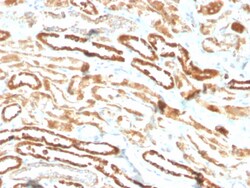
Biotium Erythropoietin (EPO) (Marker of Placentation Disorders)(EPO/3793R), CF740 conjugate, 0.1mg/mL
Recognizes a protein of about 37 kDa, which is identified as Erythropoietin (EPO). Erythropoietin is a secreted, glycosylated cytokine hormone composed of four alpha helical bundles. It is the primary factor responsible for regulating erythropoiesis during steady-state conditions and in response to blood loss and hemorrhage in the adult organism. Erythropoietin is synthesized by the kidney and stimulates the proliferation and maturation of bone marrow erythroid precursor cells. The protein is found in the plasma and regulates red cell production by promoting erythroid differentiation and initiating hemoglobin synthesis. Primary antibodies are available purified, or with a selection of fluorescent CF Dyes and other labels. CF Dyes offer exceptional brightness and photostability. Note: Conjugates of blue fluorescent dyes like CF405S and CF405M are not recommended for detecting low abundance targets, because blue dyes have lower fluorescence and can give higher non-specific

Biotium Luteinizing Hormone / Choriogonadotropin Receptor (LHCGR) (LHCGR/1415), CF740 conjugate, 0.1mg/mL
This antibody recognizes a protein of 78-85 kDa, which is identified as luteinizing hormone/choriogonadotropin receptor. Luteinizing hormone plays a role in spermatogenesis and ovulation by stimulating the testes and ovaries to produce steroids. Choriogonadotropin production in the placenta maintains estrogen and progesterone levels during the first trimester of pregnancy. Ovaries and testes abundantly express luteinizing hormone/choriogonadotropin receptor (LHCGR) as a seven transmembrane, G protein-coupled receptor glycoprotein. LHCGR influences the protective effect of pregnancy and Gonadotropin against breast cancer. The expression of LHCGR on breast carcinoma correlates in part to the degree of tumor differentiation. LHCGR -positive breast tumors occur more frequently in tumors with greater cell differentiation in premenopausal women.Primary antibodies are available purified, or with a selection of fluorescent CF Dyes and other labels. CF Dyes offer exceptional brigh

Jackson Immuno Research Labs Alexa Fluor 594-IgG Fraction Monoclonal Mouse Anti-Sheep IgG Light Chain Specific (min X Bov Hrs Hu Ms Rb Rat Ig)
Alexa Fluor 594-IgG Fraction Monoclonal Mouse Anti-Sheep IgG Light Chain Specific (min X Bov Hrs Hu Ms Rb Rat Ig)
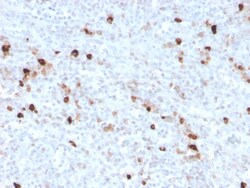
Biotium Human IgM (Immunoglobulin Mu Heavy Chain) (B-Cell Marker)(IGHM/3776R), 0.2mg/mL
Recognizes a protein of 75 kDa, identified as mu heavy chain of human immunoglobulins. It does not cross-react with alpha (IgA), gamma (IgG), epsilon (IgE), or delta (IgD), heavy chains, T-cells, monocytes, granulocytes, or erythrocytes. This MAb is useful in the identification of leukemias, plasmacytomas, and certain non-Hodgkin's lymphomas. The most common feature of these malignancies is the restricted expression of a single heavy chain class. Demonstration of clonality in lymphoid infiltrates indicates that the infiltrate is clonal and therefore malignant. Primary antibodies are available purified, or with a selection of fluorescent CF Dyes and other labels. CF Dyes offer exceptional brightness and photostability. Note: Conjugates of blue fluorescent dyes like CF405S and CF405M are not recommended for detecting low abundance targets, because blue dyes have lower fluorescence and can give higher non-specific background than other dye colors.
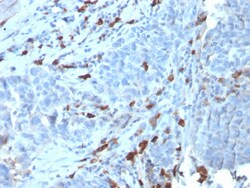
Biotium Human IgM (Immunoglobulin Mu Heavy Chain) (B-Cell Marker)(IGHM/3135R), 0.2mg/mL
Recognizes a protein of 75 kDa, identified as mu heavy chain of human immunoglobulins. It does not cross-react with alpha (IgA), gamma (IgG), epsilon (IgE), or delta (IgD), heavy chains, T-cells, monocytes, granulocytes, or erythrocytes. Monomeric IgM is expressed as a membrane bound antibody on the surface of B cells and as a pentamer when secreted by plasma cells. IgM antibody is prominent in early immune responses to most antigens. Aberrant levels are associated with immune deficiency states, hereditary deficiencies, myeloma, Waldenstrom's macroglobulinemia, chronic infection and hepatocellular disease. This MAb is useful in the identification of leukemias, plasmacytomas, and certain non-Hodgkin's lymphomas. The most common feature of these malignancies is the restricted expression of a single heavy chain class. Demonstration of clonality in lymphoid infiltrates indicates that the infiltrate is clonal and therefore malignant. Primary antibodies are available purified, or w
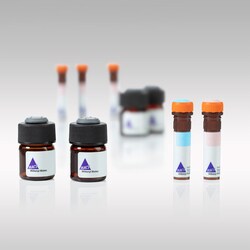
Miltenyi Biotec, Inc. CD307a (FcRL1)-APC, mouse 200 tests
Identification and enumeration of CD307a (FcRL1)+ cells by flow cytometry.
This product is subject to the following: Miltenyi Biotec, Inc. Terms and Conditions of Sale For Products and Services
CPC Scientific H-Asn-Ser-Lys-Met-Ala-His-Ser-Ser-Ser-Cys-Phe-Gly-Gln-Lys-Ile-Asp-Arg-Ile-Gly-Ala-Val-Ser-Arg-Leu-Gly-Cys-Asp-Gly-Leu-Arg-Leu-Phe-OH (trifluoroacetate salt) 0.5MG
Brain natriuretic peptide or B-type natriuretic peptide (BNP) (also ventricular natriuretic peptide) is a 32-amino acid peptide secreted by heart ventricles in response to excessive stretching of heart muscle cells (cardiomyocytes).ONE-LETTER SEQUENCE: NSKMAHSSSCFGQKIDRIGAVSRLGCDGLRLF (Cys10 and 26 bridge)MOLECULAR FORMULA: C146H239N47O44S3MOLECULAR WEIGHT:3453STORAGE CONDITIONS: -20 5C, CAS REGISTRY NUMBER: [133448-20-1], RESEARCH AREA: CardiovascularREFERENCES: M. Kojima et al., BBRC, 159, 1420 (1989)
